Where Flowers Bloom and Stories Take Root
Because every garden has one
Every army wife will agree with me when I say this: our gardens are our pride. No matter which corner of the country we move to, our plants follow us. Sometimes in crates, sometimes in buckets, sometimes in whatever container we can find at midnight before a posting. We fuss over roses, pamper lilies, reason with bougainvillea and encourage petunias like shy children. There is something deeply instinctive about army wives and gardens. We arrive at a new house and the first thing we do is imagine where the plants will go. This love quietly stays with us long after uniforms are hung up for good.
Back in 2010, when Station HQ announced the Annual Garden Competition, the entire officers’ lane slipped into a familiar mode. Not panic. Not pressure. Just that gentle buzz of excitement mixed with curiosity. Morning walks slowed down considerably. People paused longer near hedges. Pots were examined with new interest. Sahayaks discussed soil and compost with remarkable seriousness. Every officer’s wife was suddenly thinking in colour palettes and plant groupings.
Some gardens were already extraordinary. One friend had created something completely different from the rest. Her garden followed a Japanese inspired style with clean lines, balance and space to breathe. White pebbles bordered quiet green patches. A low stone path guided you gently through the space. A bamboo water spout released a soft, rhythmic trickle while lanterns sat close to the ground, glowing quietly at dusk. Bonsai style plants rested in ceramic pots, moss crept naturally between stones and mogra buds added fragrance without demanding attention. It was calm, thoughtful and composed. You did not walk through it. You slowed down inside it.
My garden, meanwhile, had ambition. The flowers bloomed with personality. The money plant travelled wherever it pleased. The marigolds occasionally refused to cooperate. But I was determined. Mornings were spent watering, talking to my plants, rearranging pots and stepping back to judge angles like an interior decorator with muddy feet. My sahayak worked diligently too, trimming hedges, aligning pots and tending to the beds, making sure everything looked cared for and ready.
And then came the moment that only motherhood can deliver
I discovered it the next morning while rearranging my pots with quiet satisfaction. As I shifted one terracotta planter slightly, something looked odd. The soil beneath had a different texture. Fresh. Purposeful. I bent down and froze.
Right in the middle of my carefully planned garden was a perfectly dug rectangular patch. Neat. Confident. Intentional. It looked like a project that had received full approval.
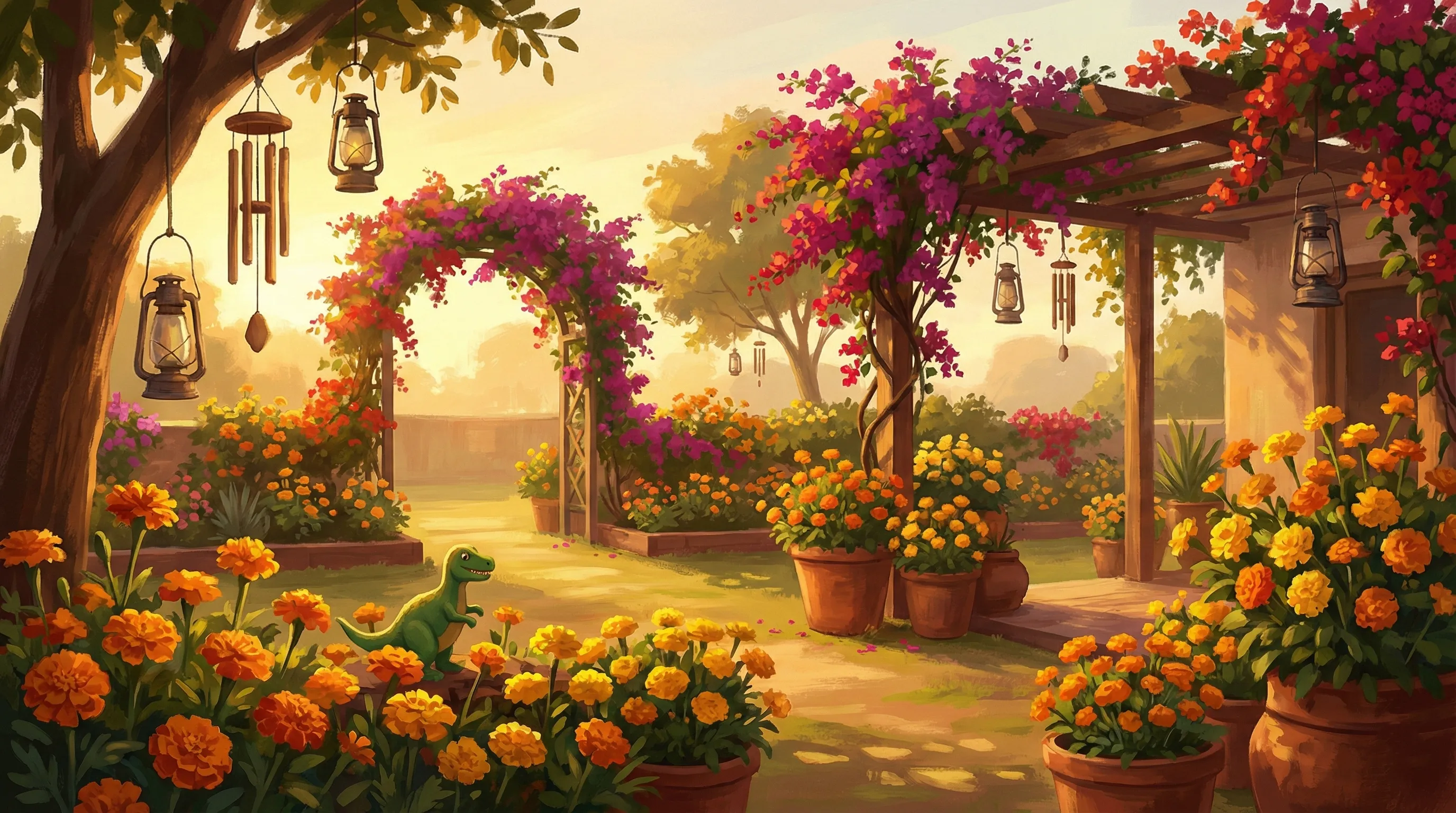
Inside it were planted five onions, two potatoes, one garlic bulb and one enthusiastic chunk of ginger. A twig fence marked the boundary. At one corner stood my son’s toy dinosaur, alert and very clearly in charge.
I stood there in silence long enough for my shock to fully develop.
When asked, my son looked genuinely surprised that I needed an explanation and said, very calmly, Mumma, you are showing your garden for the competition. I also wanted to show my garden. So now there are two.
Only later did I learn that he had very firmly persuaded my poor sahayak to help him dig the area. The entire operation had been carried out quietly, efficiently and without raising any suspicion. The confidence of children is truly unmatched.
What followed was a gentle rescue mission. Vegetables were retrieved with care. Soil was smoothed. Displaced marigolds were comforted and replanted. Pots that had been shifted to make space were returned. The dinosaur remained. Removing it would have felt disrespectful.
All around us, the lane was blooming beautifully. Bottle gardens hung gracefully. Shells shimmered softly in the breeze. Wind chimes hummed. Terracotta bells added warmth. Pastel tyre planters framed entrances. Narrow stone paths guided visitors through phlox, dahlias, lilies, pansies and neatly trimmed greens. Even the raat ki rani bloomed right on schedule, as if fully aware of the occasion.
On the day of inspection, we all mastered the art of looking casual while silently hoping our plants behaved themselves. The judges walked slowly, admiring chrysanthemums, leaning closer to lilies, pausing thoughtfully at hibiscus blooms. My friend’s Japanese inspired garden looked serene and composed. Mine looked cheerful and colourful and thankfully showed no sign of underground vegetables.
The results were scheduled after a fortnight, which meant everyone finally relaxed once the judges left. That evening, as always, we gathered for tea and pakoras. Stories were retold. Gardens were analysed. Laughter flowed freely. My son’s vegetable patch became the highlight of the conversation and was discussed with far more enthusiasm than any ribbon or certificate.
Some said he had initiative. Others felt he had great vision. Everyone agreed he had provided the best entertainment of the season.
Looking back, I realise it was never about winning. It was about creating something with love. About friendships built across fences. About plants exchanged instead of gossip. About evenings where laughter mattered more than results.
Even today, whether in service or retired, army wives continue to nurture gardens with the same devotion. Pots are still arranged with care. Bougainvillea is still trained patiently over arches. Small handmade decor still finds a place in corners. The love for plants quietly travels with us.
And yes, I still keep an eye on the onion basket. Some ideas have a habit of returning.